Hickey & Hickey & Attorney-General for the Commonwealth
[2003] FamCA 395 · Full Court of the Family Court of Australia
Articulated the sequential s 79 analysis applied (in its post-2024 form) in every Australian property settlement, including those involving superannuation splits under Part VIIIB.
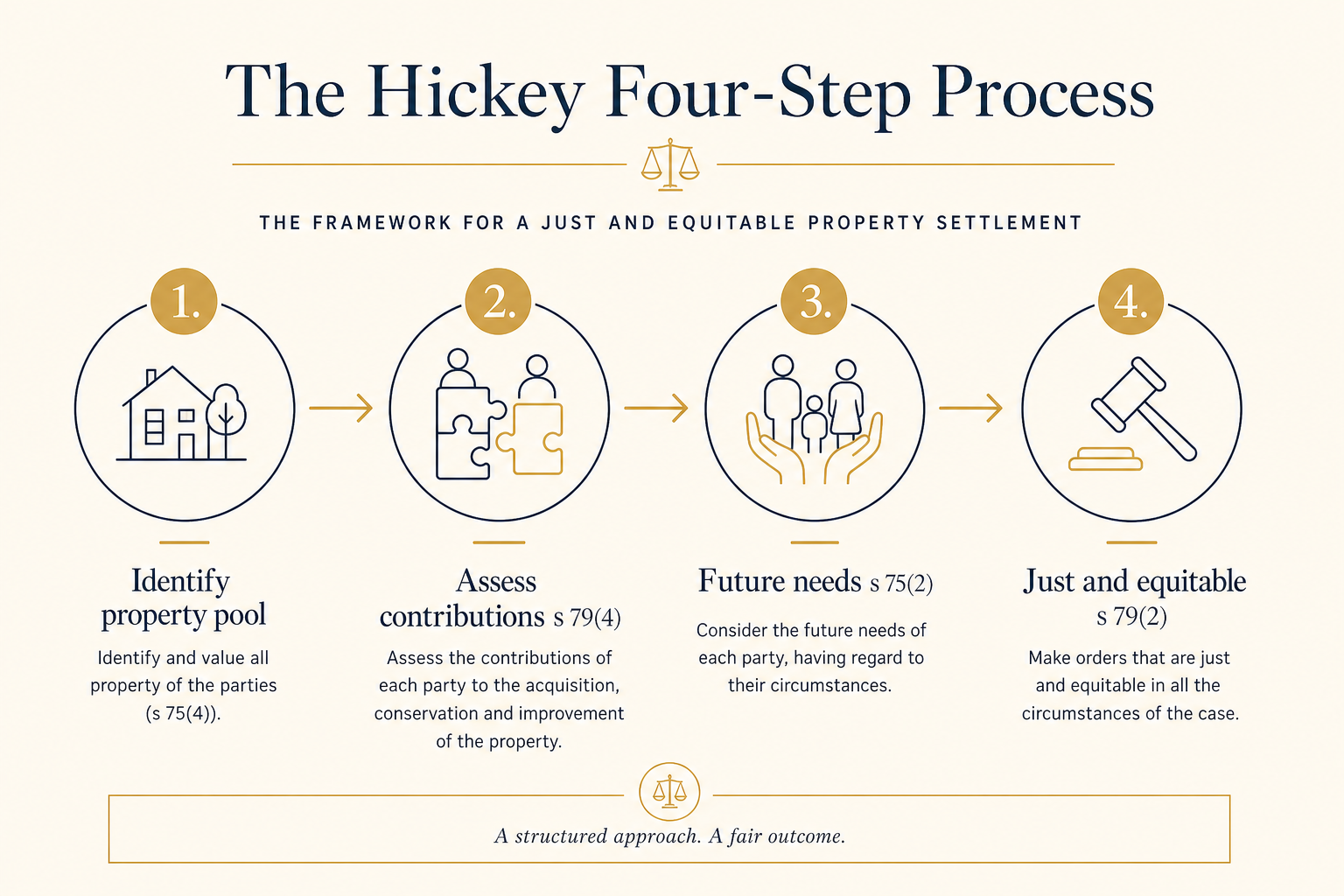
Stage 1 — Identify and value the property pool
The Court must first identify all assets, liabilities and financial resources of both parties as at the date of hearing (not separation). Superannuation interests are 'property' for Part VIIIB purposes and must be valued under the Family Law (Superannuation) Regulations 2001 — accumulation interests at member balance, defined benefit interests using the prescribed scheme-specific or default factor.
Stage 2 — Assess contributions under s 79(4)
The Court weighs financial contributions (s 79(4)(a)), non-financial contributions (s 79(4)(b)) and homemaker / parent contributions (s 79(4)(c)). Pre-relationship superannuation enters here as an initial financial contribution. The actuarial 'roll-forward' of that opening balance to today's dollars is the evidence the Court relies on.
Stage 3 — Section 79(5) factors (formerly s 75(2))
Age, health, care of children, earning capacity, and crucially — disparity in superannuation balances at retirement age — are weighed. A small s 79(5) adjustment in favour of the lower-balance party is common, but it operates after the contribution-assessment stage, not in place of it.
Stage 4 — Just and equitable under s 79(2)
The Court stands back and asks whether the resulting orders are 'just and equitable' under s 79(2), now codified by the Family Law Amendment Act 2024. Stanford v Stanford (2012) 247 CLR 108 reinforces that this is an independent threshold — not a rubber stamp.
Why this matters for your matter
If you brought super into the relationship and cannot put a defensible Step-2 number in front of the Court or your mediator, your initial contribution will be assessed at zero. Run the estimator to see your indicative grossed-up figure, then consider commissioning a fixed-fee report.
Quantify your Hickey argument with a defensible number.